Showing posts with label preschool education. Show all posts

Monday, September 25, 2023

3 Fun Ways to Learn About Cultural Diversity in the Preschool Environment

Preschool is a crucial time for children to begin their journey of understanding and appreciating cultural diversity. In the early years, fostering an appreciation for different cultures lays a foundation for empathy, respect, and open-mindedness. To make this learning experience enjoyable and meaningful try using engaging approaches such as those discussed here.

  1. Cultural Storytelling

In a Montessori preschool environment, teachers will carefully select books and stories that feature characters, settings, and traditions from diverse cultures. As they read these stories to the children, it opens the door for discussions about cultural diversity. By asking thought-provoking questions like, "How is this culture different from our own?" or "What can we learn from the characters in this story?", students are encouraged to use critical thinking and explorative curiosity.
Moreover, incorporating diverse stories into daily reading time helps children relate to characters from various backgrounds and fosters a sense of connection with the wider world. These stories can also be complemented by age-appropriate discussions that encourage children to share their thoughts and observations about the cultures presented in the stories.

  1. Multicultural Arts and Crafts

Arts and crafts activities are a hands-on and creative way to explore cultural diversity in preschool. Teachers can plan art projects that celebrate different cultures, encouraging children to create art inspired by various traditions. Examples include Mexican papel picado banners, African masks, or Chinese lanterns. 

These projects not only foster creativity but also provide opportunities for children to learn about the aesthetics, symbols, and artistic techniques associated with different cultures. Displaying the children's multicultural artwork throughout the classroom creates a visually diverse environment that celebrates the uniqueness and beauty of various cultures.

  1. Global Cuisine Adventures

Food is a universal and delightful way to introduce preschoolers to different cultures. Teachers and parents can organize occasional cooking or snack sessions where children get to prepare and taste dishes from around the world. Selecting simple and child-friendly recipes that allow children to engage their senses and explore new flavors and textures.
During these culinary adventures, share information about the origins of the dishes, the significance of certain ingredients, and unique dining customs. These discussions not only broaden children's palates but also teach them that food is a gateway to understanding the traditions and lifestyles of people from diverse backgrounds.


Exploring cultural diversity in the preschool environment through storytelling, multicultural arts and crafts, and global cuisine adventures can be both fun and educational. These engaging approaches expose young learners to the richness of different cultures while encouraging empathy, critical thinking, and creativity.


Wednesday, August 30, 2023

Helpful Ideas Parents Can Use to Motivate Their Montessori Reader


As parents navigate the journey of nurturing their child's reading skills within the Montessori framework, a proactive and supportive approach can make a significant difference. Let's look at a few practical strategies, enhanced with additional insights, that parents can use to motivate their preschool readers.

Create a Reading-Friendly Environment

Setting the stage for a reading-friendly environment at home can ignite a Montessori preschool child's curiosity and love for reading. Designate a cozy reading corner filled with a variety of age-appropriate books, allowing your child to explore their interests. Regular visits to the library can also expose them to new genres and authors, fostering a sense of excitement. By making reading an integral part of their daily routine, parents create a space where learning and imagination thrive. This environment cultivates not only reading skills but also a sense of wonder and exploration.

Celebrate Reading Progress

Recognizing and celebrating a child's reading progress is a powerful motivator. Set achievable reading goals together and celebrate milestones, whether it's completing a certain number of pages or finishing a book independently. Offer praise and acknowledgment, instilling a sense of accomplishment. Additionally, engage in meaningful discussions about the stories they read, encouraging critical thinking and enhancing their comprehension skills. This positive reinforcement reinforces their dedication to reading. As parents, your enthusiasm for their reading journey becomes a powerful catalyst for their own excitement.

Embrace Choice and Variety

Incorporate an element of choice into your child's reading journey. Allow them to select books that align with their interests, whether it's adventure, animals, or science. Providing a range of reading materials, including magazines, comics, and eBooks, introduces variety and keeps their enthusiasm alive. Let them explore different formats and genres, empowering them to cultivate a diverse reading palette. By nurturing their autonomy in choosing what to read, parents encourage a sense of ownership and agency over their learning.

Motivating Montessori readers involves creating an environment that encourages exploration, celebrating progress, and embracing variety. By establishing a reading-friendly space, celebrating achievements, and offering choices, parents can foster a deep-rooted love for reading. This love transcends the confines of early childhood, laying the foundation for a lifelong habit of exploration and learning through literature. As parents actively engage in their child's reading journey, they pave the way for a future of discovery and growth.

Thursday, July 27, 2023

4 Benefits of Pink Towers, Red Rods and Brown Stairs in Montessori

Montessori education emphasizes hands-on learning experiences that foster a child's natural curiosity and cognitive development. Among the many materials used in preschool classrooms, the Pink Tower, Red Rods, and Brown Stairs stand out as iconic and invaluable tools. These sensorial materials play a crucial role in developing various skills, nurturing a child's senses, and laying the foundation for future academic achievements. Let's take a closer look at four key benefits of incorporating Pink Towers, Red Rods, and Brown Stairs into Montessori learning environments.

  1. Enhancing Sensorial Development

The Pink Tower, composed of ten pink cubes varying in size, allows Montessori preschool children to refine their visual and tactile senses. As they stack the cubes from the largest to the smallest, they develop their sense of size, dimension, and spatial awareness. Similarly, the Red Rods, a set of ten red wooden rods varying in length, aids in developing the sense of length and discrimination. Children arrange the rods in ascending order, honing their ability to differentiate between sizes based on visual cues. The Brown Stairs, a series of ten rectangular wooden prisms varying in both length and width, further refines the sense of size and dimension.

  1. Promoting Fine Motor Skills

Working with the Pink Tower, Red Rods, and Brown Stairs requires precise movements and coordination of hand and eye. As children carefully manipulate the cubes, rods, and prisms, they enhance their fine motor skills and hand-eye coordination.

  1. Fostering Order and Concentration

The orderly presentation and systematic use of the Pink Tower, Red Rods, and Brown Stairs instill a sense of order in the learning environment. Children learn to follow a sequence, respect the material, and return each piece to its designated place. This practice nurtures discipline and concentration as children engage in purposeful, self-directed activities.

  1. Early Math and Geometry

The Pink Tower, Red Rods, and Brown Stairs lay the groundwork for abstract mathematical and geometrical concepts. Through manipulation and comparison of the materials, children develop an understanding of size relationships, spatial awareness, and mathematical principles like seriation, conservation, and geometric progression. This sensorial foundation is a precursor for later math lessons, fostering a solid understanding and appreciation for mathematical concepts.


The Pink Tower, Red Rods, and Brown Stairs exemplify the brilliance of Montessori sensorial materials and their role in supporting a Child's development. By enhancing sensorial perception, promoting fine motor skills, fostering order and concentration, and laying the groundwork for mathematical concepts, these materials become invaluable tools in the Montessori environment. 


Wednesday, May 31, 2023

How Does Developing Fine Motor Skills Benefit Other Developmental Areas?


Fine motor skills refer to the coordination and control of small muscles in the hands and fingers. While often associated with preschool activities such as writing and drawing, the development of fine motor skills goes beyond these specific tasks. In fact, the acquisition of fine motor skills can have a significant impact on other areas of a child's development. Here are a few examples of how developing fine motor skills benefits other developmental areas, highlighting the importance of these skills in a child's overall growth.

Cognitive Development

When Montessori preschool children engage in activities that require precise hand and finger movements, such as stacking blocks or completing puzzles, they are simultaneously enhancing their cognitive abilities. Fine motor activities stimulate problem-solving, spatial awareness, and hand-eye coordination. The manipulation of objects and tools strengthens their ability to understand and navigate their physical environment.

Language and Communication

Fine motor skills are closely linked to language and communication development. As children develop the ability to control their hand and finger movements, they also enhance their oral and written communication skills. Activities such as holding a pencil, drawing, and manipulating small objects strengthen the muscles involved in speech production. Additionally, fine motor activities foster hand-eye coordination, which is essential for reading and writing.

Social and Emotional Development

Fine motor skills also contribute to social and emotional development. When children engage in fine motor activities, they often work alongside their peers, promoting social interaction, collaboration, and teamwork. Through these activities, children learn to take turns, share materials, and communicate effectively. Fine motor tasks also provide opportunities for children to express their creativity and emotions.

Practical Life Skills

Fine motor skills are essential for performing routine tasks independently. From buttoning clothes to tying shoelaces, developing fine motor skills enables children to master these self-care activities. Fine motor activities, such as using utensils during mealtime or brushing teeth, support the development of fine motor control and coordination required for these tasks. As children gain proficiency in fine motor skills, they become more self-reliant and capable of managing their daily routines.

The development of fine motor skills has a far-reaching impact on various areas of a child's overall development. From cognitive abilities to language and communication skills, social and emotional development, and daily living tasks, fine motor skills play a vital role in shaping a child's growth. By providing opportunities and support for fine motor development, parents and caregivers are fostering a strong foundation for a child's holistic development and future success.

Monday, February 27, 2023

4 Developmental Math Concepts that Montessori Children Learn in Preschool

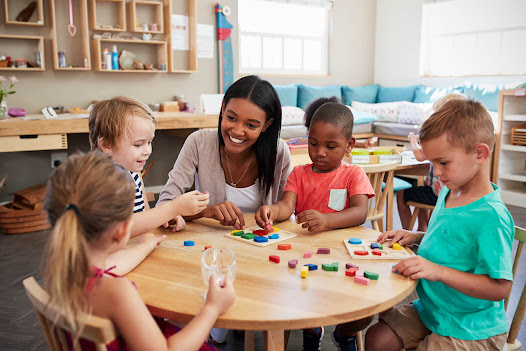
Math is part of almost everything we do, even though a lot of it takes place without conscious effort. For preschool children, these skills have only begun to develop, and they will be learning the fundamental concepts of math as early as preschool. Hands-on activities are excellent for promoting math skills because children can manipulate the objects that they are learning from.

  1. Sorting

An important activity for Montessori preschool children is learning to sort objects. Whether the criteria are size, shape, color, texture, or some other factor, dividing objects into groups helps small children develop critical thinking skills, hone fine motor skills, and offer an entertaining framework for learning small kids thrive on.

  1. Counting

Learning to count is the next step in math skills. Counting puts a value on sets and shows how numbers can be manipulated. This skill gets practiced in the course of other activities, including practical skills such as measuring and pouring. In a natural environment, children will begin practicing before they learn the names of numbers, and can often be seen arranging favorite objects in numerical sets, and noticing when a member of the set is absent.

  1. Patterns

Putting together puzzles involves abstract math use such as counting lobes on a puzzle piece, learning how shapes can be interlocked to form another shape, and more. Critical thinking is a vital skill that can be reinforced with puzzles and has applications in everything from arithmetic to social interaction. Sorting, counting, and patterns are all members of the same subset of math, and incorporating them into preschool activities will benefit the child as her education progresses.

  1. Basic Operands

The concepts of addition and subtraction begin developing long before a child knows how to express the words or processes they are using to do the job. For this reason, the basic progression into elementary math generally goes smoothly, but instills the vocabulary and logic of basic operands with example and practice.


Science, Technology, Engineering, Arts, and Math-- the STEAM subjects-- are essential subjects for tomorrow's leaders, and each of them depends on mathematics in some way, making it especially important that today's young children begin learning about math concepts as soon as they become communicative.


Tuesday, January 31, 2023

Is Preschool the Right Time to Enroll My Child in Montessori Education?


The Montessori Method works best when children begin in preschool. It is possible to bring children into Montessori as late as kindergarten, but kids are far more successful when Montessori is introduced as early in preschool as possible. Adapting from traditional classrooms to Montessori is more challenging for the child because it requires her to adopt a completely different approach to learning.

Early Development


Maria Montessori believed that early development was a crucial part of education because that is when children's minds and muscles are being nurtured. She called the period between daycare and kindergarten the Absorbent Mind in acknowledgment of the way children are eager to learn more about themselves and the world they live in. For small children, everything is new and interesting, and Montessori preschool can maximize that by encouraging curiosity and performance.

A Consistent Environment


A Montessori preschool tends to be quieter and more focused, and much of that owes to the prepared environment of Montessori. By keeping everything in the same place and teaching children to put items away when they are not in use, the classroom never becomes cluttered, and after a few days children learn that their favorite activities will always be in the same place.

Discipline is handled in much the same way, with classroom rules and etiquette clearly defined and always expected. Montessori avoids rewards and punishments, instilling children with internal motivation to do the right thing, whether that means participating in group activities, controlling emotional outbursts, or sharing a favorite toy with a classmate.

Montessori and Learning Challenges


Children with learning challenges such as ADHD or autism often respond to Montessori education positively. Because it is structured and consistent, children adapt readily to the Montessori Method. Additionally, the ability to move freely between activities means that children can move on to other activities rather than being forced to continue using one that no longer interests them.

The earlier a child begins learning with the Montessori Method, the better it will be for the child. If possible, children should begin in daycare, but the nature of Montessori makes it easier for children to begin when they are a few years older. In fact, it is typically more difficult for a child to adapt to more traditional educational systems from a Montessori beginning, than the other way around.

Tuesday, November 29, 2022

How to Encourage Your Preschool Child Read More at Home

Reading is one of the most valuable skills your preschool daughter will have. Her teachers are helping her read at school, but it is also important for you to encourage reading at home as well. Kids spend more time at home than at school, and opportunities to read can be found almost anywhere you look. Here are some great ideas you can use to assist your daughter in developing a love for words and reading.

Be A Good Example

One very effective way to get Montessori preschool children to read is to let them see-- and hear-- you reading. Make it a habit to read books and magazines, read recipes aloud as you prepare them, and use every opportunity to demonstrate to your daughter that words are important. 

Read  Along

Read with your children, taking the time to examine each page, and talking about the action depicted. This helps children develop critical thinking, builds a strong vocabulary, and helps small kids learn more about themselves and the world. Reading aloud to children is beneficial for kids with verbal challenges as well, because it allows the child to see up close how the mouth moves when words are pronounced.

Provide A Variety

Reading preferences are different from one child to another and children will learn at different paces. Fill the lower bookcase shelves with a variety of age-appropriate books and give your daughter the freedom to choose which ones she likes best. Don't hesitate to go a couple of years older with the material, but concentrate on books with short words, rhymes, and exciting subjects. In addition to children's books, try including a couple of pictorial tomes on nature, animals, and the like.

Word-A-Day

Make a game out of learning a new word every day. You can do this by setting up an erasable whiteboard and using appropriate markers. Choosing the word can be done any way you wish, or simply open a dictionary with your eyes closed and place your finger on the page. With your daughter, practice saying the word, then write it in her journal and talk about what it means and how it should be used in conversation. This provides an important link between printed words and spoken language.


Printed writing has been the way people have kept records for thousands of years, and was done using pictures instead of words even before that. The art of writing is even more important today, and the success of every school student relies on developing strong reading skills and comprehension. 


Wednesday, August 31, 2022

Why is Montessori Preschool Important for Early Development?

Preschool is the most important period for children to gain the many personal tools needed for later education and eventually interacting in the community. This includes fine and gross motor skills, social etiquette, academic lessons, and learning to perform practical tasks such as measuring, pouring, and cutting.

Mixed Age Groups

The 3-year age group used in a Montessori preschool conforms to a natural order observed by Maria Montessori when watching a group of children. It allows children to spend more or less time learning specific lessons without "falling behind," and it helps children develop interactive skills and self-esteem by cycling through being the oldest-- thus more experienced-- children in the room.

Hands-On Activities

Authentic Montessori activities are designed to be apparently useful, self-correcting, and appealing. This is true of classroom activities such as the Pink Tower as well as nature and natural activities. Each activity is meant to be interesting so that children will take notice, engaging so that children want to use it repeatedly, and self-correcting so the child will know if the task was performed correctly without requiring affirmation from someone else.

Interactive Skills

Montessori children often work together to accomplish tasks, and the Montessori Method makes developing language and social skills one of the highest priorities for early education. Social etiquette is practiced constantly and consistently so that children absorb the rules of social behavior as they grow and without singling out courtesy and grace as a task rather than the natural means of interaction.

Nature in Education

Nature and our relationship with it is a primary tool of Montessori education. From playground games to learning about plants and frogs, children are encouraged to become immersed in learning about the world they live in. Getting outdoors was considered a vital part of early development, and Maria Montessori incorporated nature-based activities into the Montessori Method.

Learning Leadership

Montessori encourages and promotes self-esteem, critical thinking, and social interaction. As a result, children who attend Montessori schools develop the basic skills necessary for leadership activities concurrently with other education goals. And because of Montessori's mixed-age classes, all of the children spend a portion of their education among the oldest children in the class, instilling leadership skills as a natural progression of events.


Montessori promotes a more holistic style of teaching that instructs children on multiple levels and addresses all of the developmental milestones of early education. Children learn to read and write as they gain the skills needed to add and subtract, along with the critical thinking and social responsibility vital to peaceful interactions with other children and adults. 


Friday, July 29, 2022

5 Examples of Differences Between Montessori and Traditional Public Schools

Preschool children tend to perform well in a Montessori environment. As an alternative to traditional schools, Montessori stands apart from other educational strategies because the Montessori Method is designed around children, focusing on helping each child develop in a natural manner using special activities and a completely different teaching style.

  1. Children First

Traditionally, all of the children in a class are expected to always be on the same page, working on the same projects, and using the same materials. By contrast, Montessori preschool students work individually. This is only one example of how Montessori puts individual development first, but the classroom itself is another example, with everything designed to be more comfortable and appealing to the children in the room.

  1. Observation and Guidance

Montessori teachers are called guides because guidance, not instruction, is their primary function. Student guides do not spend the day lecturing to the class as a group. Their approach is to observe the progress of individuals and gently guide them toward new activities or goals that help each child at a personal level.

  1. Hands-On Activity

Independent research has demonstrated the effectiveness of learning through doing, but Montessori students have always used a play-based educational system. Maria Montessori recognized that children are learning when they are at play and designed activities around the idea that children will learn more readily when the task at hand is also enjoyable and engaging.

  1. Mixed Age Groups

Children in the Montessori preschool are learning different skills at different speeds. In a traditional classroom where all of the kids are within months of the same age, this method would be problematic but in a class with a 3-year age spread every child has ample opportunity to learn at a pace that suits them instead of struggling to stay in step with other students.

  1. Practical Experience

There isn't much room for learning to perform practical tasks in a traditional public school environment. Montessori teaches children to perform these tasks as a fundamental part of the educational process, including routine chores and lessons about culture, language, and math, and as a tool for developing important social skills. The end result is a child who not only learns academically, physically, and socially but gains practical experience in real-world tasks as they do so.


Montessori is vastly different from traditional educational approaches. It allows more freedom of choice but demands more focus on learning. It is self-guided and self-correcting, and Montessori is more fully involved in helping the child develop along several developmental paths in unison.


Monday, June 27, 2022

3 Developmental Music and Movement Activities I Can Do With My Preschool Child

Preschool children have a lot to gain from activities that involve music and movement. Songs and music teach language, and songs that provide movement incentives help develop skills needed for other activities. Putting their right foot in and pulling their right foot out bolsters coordination, teaches children the difference between right and left, builds vocabulary, and encourages the development of fine and gross motor skills.

  1. Be a Role Model

When your Montessori preschool children see you singing along to the radio or dancing about the room, they want to imitate what you do. To that end, the single biggest thing you can contribute in early child development is to be a great role model, showing your children the kind of activities you want them to mimic. Sing to your child, hold his hands and dance with him, and encourage him when he begins to be-bop around the room himself.

  1. Sing-Alongs

Singing along to children's songs helps preschool children develop a stronger vocabulary, helps them learn valuable lessons about themselves and the world, and more. Set aside a little time each day to sing along to some songs, take note of the ones your child enjoys the most, and encourage him to sing along when a favorite tune comes on the radio. Because whether you are singing Itsy-Bitsy Spider or a top-10 pop song you are helping your child learn to speak more fluently and providing other important developmental skills in language, fine motor skills, and more.

  1. Dance With Me

Clapping their hands, stomping their feet, and swaying to and fro in time to music helps children develop vital fine and gross motor skills. Fine motor skills are necessary for gripping and manipulating small objects, and gross motor skills are used for running, jumping, climbing, and more. Dancing with your child is a valuable activity that goes far beyond the actual music and movements taking place.


If you're happy and you know it, clap your hands, and encourage your preschooler to sing along, move along, and participate. Praise his style and ability, because your praise builds his self-esteem, and children who feel good about their abilities are more willing to use them. For small children, everything they do is an educational activity and the more ways you are able to encourage his participation, the faster and easier early childhood development will be.


Friday, February 25, 2022

5 Important Pool Safety Tips for your Montessori Preschooler

All preschool children should be taught the basic pool rules before summertime arrives. From knowing when to avoid the pool to learning what must be done if someone in the water is in trouble, understanding teaches your kids to be pool safe sets the foundation for summer full of worry-free fun.

  1. Never Swim Alone

Preschool children should be taught that an adult should always be present before entering the pool area. A fence should be installed around the area, with a locked gate. It is best to take this a step further and make sure the key itself is not accessible to young hands.

The "Buddy System" is one of the most important rules of pool safety, and kids should be taught to abide by it as early as possible. The idea is that no one, not even adults, should spend time alone at the pool because bad things can happen. 

  1. No Running in Pool Areas

The frequency of accidental Slips and falls on wet surfaces is a great example illustrating the need for safe pool conduct. Running and horseplay are great physical activities, but they should be reserved for appropriate locations.

  1. Don't Swim In Dangerous Conditions

Pool areas should be cleared anytime a storm approaches. Even if the thunder and lightning are miles away, it may be coming closer and random strikes can occur up to 10 miles from the main storm. In colder places, unheated outdoor pools are best emptied or at least covered during cold weather, and children are taught that entering cold weather can affect their muscles and physical abilities in a negative way, making the water especially dangerous when it is cold outside.

  1. Learn to Offer Safe Assistance

There is a right way and a wrong way to help someone in trouble. First and foremost, preschool-aged children should alert an adult. To make this easier, purchase a cowbell and mount it with an easy-to-reach pull rope near the gate leading to the pool and teach your kids to ring rapidly in case of emergency.

Keep approved pool safety gear inside the pool fence where it is easily accessible. This should include a lifesaver ring on a rope, and a long pole with a soft curved end. It is vitally important to teach children not to try to reach a drowning person physically because a person in panic can put the helper in trouble as well.

  1. Put Away Pool Toys

Keeping the pool area neat and orderly is an excellent way to prevent trips, slips, and falls. This approach to safety and personal responsibility is in line with the Montessori Method and relies on a child's innate desire for order and organization.


A pool is great to have and offers hundreds of hours of good, clean fun, but it is important that preschool children learn to follow pool safety rules anytime they are near the pool. Whether at home or at a public pool, adhering to these tips will provide a better time for everyone.


Sunday, April 21, 2019

5 Toddler Friendly Apps for your Preschooler


One way to supplement your child’s preschool education is to provide him with a few toddler-friendly apps that will make good use of his online play. Simple activities like alphabet games, beginner’s math, and learning social skills are all excellent examples of apps suitable for preschoolers, and we have selected a handful of popular apps to help your child get started.